Finding My Way Back with the Backrooms

Being a critic of art is a difficult balancing act. For one, art is subjective which makes determining whether art is “good” or “bad” a pointless task. On the other hand, there is so much art to take in we tend to rely on critics to help steer us towards art that is meaningful and “worth” our time.

Of course, consuming “bad” art can still be a worthy endeavor, whether as a comparison group that helps “good” art shine or as a teacher in what not to do.

Oftentimes when I read reviews or ask people what they thought of movies the person will respond with what they wish the movie would have done and end up condemning the movie for not living up to the version made within their head.

My writing has stalled in recent years for a lot of reasons, mostly personal life events, but this idea of critiquing someone’s art when art can serve many purposes has confounded me to the point of writing paralysis.

Obviously, I am back writing now so one would think I have solved this dilemma. Well one would be wrong. I still fight with this every time I form an opinion; I continue to doubt that my point of view is worth any value, and my imposter syndrome flares up and reminds me I am far from a movie expert.

So how did I make my way back here? I recently saw a showing of Backrooms and much like the labyrinth that is the setting of the movie I don’t quite have a clear path that got me here. All I know is this film made me think and it lives in a corner of my brain where it is fighting another version of the film, the version that I wished this movie would have been.

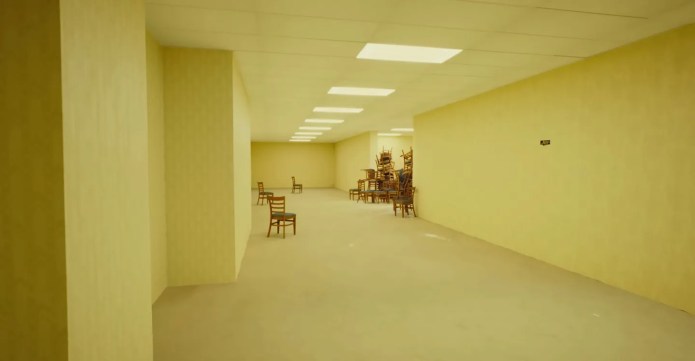
Backrooms is the directorial debut for Kane Parsons and is already, without a doubt, the most successful film based on a creepypasta of all time. It follows a furniture store owner named Clark who discovers an endless maze of yellow tinted rooms that continually get weirder and creepier as he slowly maps out the parallel dimension.

The film throws the audience into the backrooms from the jump. A POV found footage scene of…someone slowly working his way through each room. You can hear him breathe, you can hear him mumble to himself, and you can see his fear as he creeps around corners unsure of what will happen next.

This part was feeding my movie soul; I was spooked and full of curiosity. My brain was fighting contradicting desires, “run away dummy!” with “go to the next room and see what it’s like!”.

I was filled with memories of childhood curiosity. Those times I was stuck in my elementary school after hours for parent-teacher conferences. I knew it was the same building I had been to a thousand times but now it is…darker, colder, and different. I’m nervous to wander too far, I creep around the hallways with every step being intentional and calculated. I don’t dream of looking inside the gym or the cafeteria, too much space for monsters to hide.

Just as the dread and nostalgia are washing over me the movie shifts gears. We are outside of the backrooms now, following Clark as he runs his furniture store and goes to therapy. The pacing slows down and I’m dying to get back to the backrooms; I need to see more.

As the film continues, it is clear this movie is more psychological than horror. The setting is the metaphor for a middle-aged man’s life. Or maybe for the childhood trauma that his therapist survived. Or perhaps a study of humanity’s obsession with mapping out the unknowable parts of our universe.

Whatever you get from it is meaningful in its own way. The film feels like a Rorschach test, bending and twisting its form to match what an audience member sees.

That is the beauty and frustration of the movie. Like the endless rooms that Clark has to choose from as he wanders, it opens your mind with multiple possibilities, endings, and meanings.

As you leave the Backrooms you think you have it figured out. Perhaps it’s a metaphor for something that you have decided upon, or it could be just a sick Reddit joke that has gone too far, or maybe it’s just a flawed film with a brilliant premise. You are satisfied with the experience and ready to move on to the next.

But in the back of your mind, the Backrooms linger and you want just one more room, just one more walk down a hall with upside furniture, just one more hidden door in the ceiling…
Us

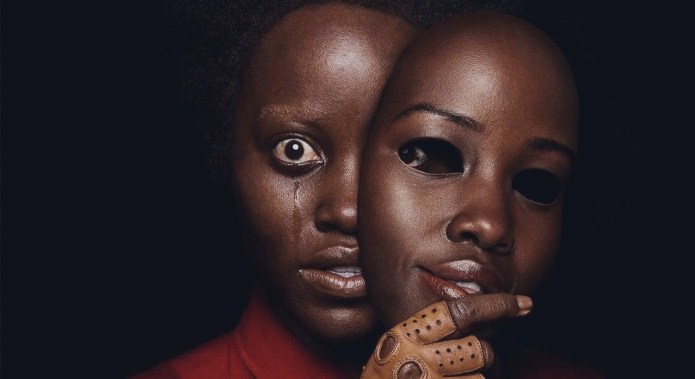
Us, filmmaker Jordan Peele’s second feature film, is a well-crafted, modern thriller that hits all of the horror beats. The film starts off as a normal home-invasion story and then somehow seamlessly works in grand conspiracy theories without disconnecting from reality. Most importantly, it’s a film that demands an instant rewatch to fully grasp the story as well as catch all the little moments and the underlying metaphors.

If you were to strip this film of the unique and haunting story you would still have a masterclass of film making to watch. From the first moment Peele’s craft is instantly on display with the opening time-establishing shot of an old TV playing a Hands Across America ad. It’s a simple moment that ends up establishing more of the plot than seems possible.

It’s still 1986 and we jump to little Adelaide’s night at the Santa Cruz amusement park. Her father wins her a Michael Jackson Thriller t-shirt and then her parents bicker and eventually become distracted. This leads to Adelaide wandering off by herself into the dark California beach. A wandering child in the dark is stressful enough but then Adelaide finds herself exploring a classic horror movie trope, a house of mirrors. And despite the classic setup, Peele finds a way to make these moments fresh, tense, and instantly memorable. An incident occurs. An incident I cannot spoil but one that is an instant classic and that sets the entire movie in motion.

And now that the entire audience is unsettled Peele doesn’t let off. The title sequence, seemingly simple, establishes the tension and the upcoming oddities with a purely haunting score and a mesmerizing visual aid. Within the first 15 minutes of the movie you are hooked and buckled up for the worst.

Unfortunately from there the film dips into standard thriller fodder. It fast forwards to modern day and presents a normal family, Adelaide, now played by Lupita Nyong’o, has grown up to be a nervous but loving mother and is married to a man that fully embraces his dad joke role in life. They have a preteen daughter, ears buds firmly entrenched, and a son that is still filled with imagination and has a belief in magic. They are staying in their summer vacation house in Santa Cruz, returning to the site of Adelaide’s “incident”. Only Adelaide’s family does not yet know what happened on the beach in 1986.

The family is enjoying their time before a group of four people show up unannounced in their driveway. Unfortunately that’s as deep into the story I can go without spoiling the good parts. Just know at this point the film goes into full thriller mode which is heart-pounding but filled with moments that are expected and not exactly memorable. Luckily even in the cliche and normal beats, the film is anchored by Lupita Nyong’o’s captivating performance of a woman who steps up to kick ass to, seemingly, protect her family.

(To illustrate just how much ass she kicks, at some point Adelaide gets out of the car to check on one of the many murderous attackers she is fighting. This is a classic, “WHY ARE YOU GETTING OUT OF THE CAR” moments that your brain loves to hate in horror movies. Except in this case your brain is like, “Actually no, Adelaide’s got this”.)

In between all the high tension thriller action, the film does bounce back and forth between 1986 and the modern day to fill some of the narrative gaps but still leaves a few frustrating questions at the end. By the end of the film I’m not confident that Adelaide’s character arc tracks completely and it feels like we were missing a few scenes that would have been connective tissue or further clues to explain our protagonist’s life. Although even as I write this I will admit this is a minor complaint and there is the possibility that a rewatch will satisfy my qualms.

And minor qualms is really all I can complain about because between this stylistic thriller hitting all of the established beats and a script that, much like Get Out, is tightly written and hardly contains a wasted moment, it’s difficult to determine if Jordan Peele is a more skilled director or writer. In fact that might be Peele’s biggest accomplishment in his short filmmaker career. It almost seems impossible for one guy to be so good so quickly.

Us is a film that you will want to come back to. It’s memorable and important just like Get Out, however it is more tense and it’s themes more understated than Peele’s first film. Get Out was in your face, screaming it’s themes at you to grab your attention. It had to be. And now that Peele has your attention, Us unequivocally proves he deserves it.